One contract, and a scoreboard that prices every decision a team makes.
One contract, and a scoreboard that prices every decision a team makes.
Executives don't learn much from being told things. They learn from decisions with consequences, made under time pressure, against rivals who want the same contract. Tech Tempest puts your leaders inside that contest: up to eight civilisation teams, one client, and a bid that must survive scrutiny, competition, and finally the storm.
There are no right answers, only trade-offs: how fast to scale, where to build, what to automate, which risks to price and which to carry. AI is in the room as an instrument, prompted, questioned, verified and overruled when the evidence demands it, which is the relationship you need your leaders to model in front of their own teams.
Hudson Hanseatic Bank is building the next generation of its digital banking, and up to eight teams compete to win the contract. A trained facilitator runs the session, and a senior leader from your organisation can play the bank: hearing the bids, asking the hard questions and deciding who wins. Four phases, each one ending in something a team has to put its name to.
Teams form, take roles, and research the client's market using AI tools, then have to show their working. Identity does the heavy lifting here: the cautious take risks, the quiet lead.
Ends with: a team, a role each, and a first read of the market.
Which features to build, tested against demand rather than opinion, and then the offer told as a story with imagery and a tagline. Coverage or a signature bet: the team has to choose a shape.
Ends with: a designed offer and the pitch that carries it.
Where the work gets done, on what infrastructure, released in what order. Nine decisions take a team from baseline to a number, with a live cost model moving under every one of them.
Ends with: a costed bid, in dollars, they have to stand behind.
The risk committee reviews the choices and prices the risk inside them. Teams see where they sit against every rival, broker partnerships, and submit a final bid to the bank.
Ends with: a submitted bid and a risk position they argued for.
Then the Tempest arrives. Sixteen segments decide who captures value and who weathers the storm, settled by the role and capability cards each team spent the day trading for. The bank reveals its budget and names the winner. Every team leaves with its offer, its costed bid, its risk position and its final ranking, and the room has watched every bid play out side by side.
The scenario is simply the stage: what your people actually practise is the small set of capabilities every organisation runs on, whatever its industry. They work out what a demanding client really needs. They shape a strategy knowing rivals are shaping theirs. They price a decision, weighing cost against risk, quality and time, and then live with the consequences in front of everyone. They use AI as a tool of inquiry, testing and verifying what it tells them rather than taking it on faith. They pitch, defend their thinking under pressure, and adapt when the storm arrives, as it always does.
A hospital, a school, a manufacturer, a government agency and a software firm all recognise these moments, because they are the moments where every organisation succeeds or fails. The bank is fictional. The judgement is real, and it travels with you.
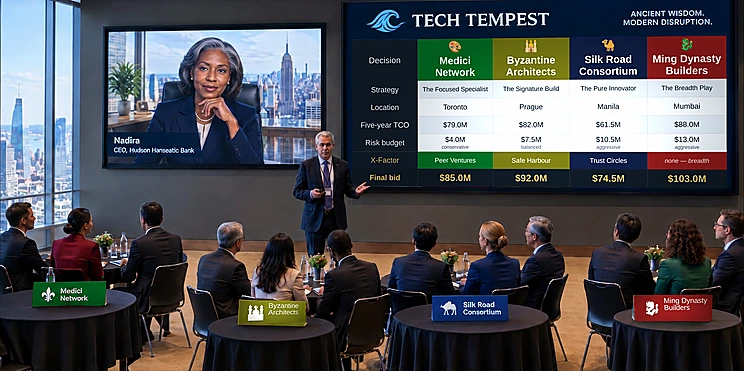
Every team's decisions land on one board, in front of everyone. It is the same board the facilitator runs live in the room, and it is the reason the arguments stay honest: a team can describe its bid however it likes, but the board shows what the bid actually is next to everyone else's.
An illustrative session. Two rival pairs, one contract. Scroll sideways for every team.
| Decision | Medici Network |
Byzantine Architects |
Silk Road Consortium |
Ming Dynasty Builders |
|---|---|---|---|---|
| Strategy | The Focused Specialist | The Signature Build | The Pure Innovator | The Breadth Play |
| Location | Toronto | Prague | Manila | Mumbai |
| Infrastructure | Hybrid | On-Premise | Cloud-Native | Hybrid |
| Release 1 loading | Conservative | Balanced | Ambitious | Stretched |
| Five-year TCO | $79.0M | $82.0M | $61.5M | $88.0M |
| Risk budget | $4.0M conservative | $7.5M balanced | $10.5M aggressive | $13.0M aggressive |
| X-Factor | Peer Ventures | Safe Harbour | Trust Circles | none — breadth |
| Final bid | $85.0M | $92.0M | $74.5M | $103.0M |
| Design award | — | Gold | Silver | — |
Two things in that table start every argument. The Silk Road Consortium built the smallest product in the cheapest city, and still bid within $10M of Medici — because Manila and a cloud build cost them $10.5M of risk budget before they priced anything else. And the Ming Dynasty Builders covered every feature but kept no signature, which is what a breadth play costs you. A low bid is not automatically the strong one. Then the storm arrives and prices what each posture was really worth, because risk is not a section of the bid document. It is something you either paid for or you didn't.
The session runs as a conference session, a half-day sprint or the full day. What your organisation needs to provide, what we bring, and how big a group it takes are all set out on the Tech Tempest page.
Tell us the format you have in mind, the size of the group and who is in the room, and we will come back with dates and a price.
Book a Session