A simulation where your leadership team decides how far to automate one process, and lives with the arithmetic.
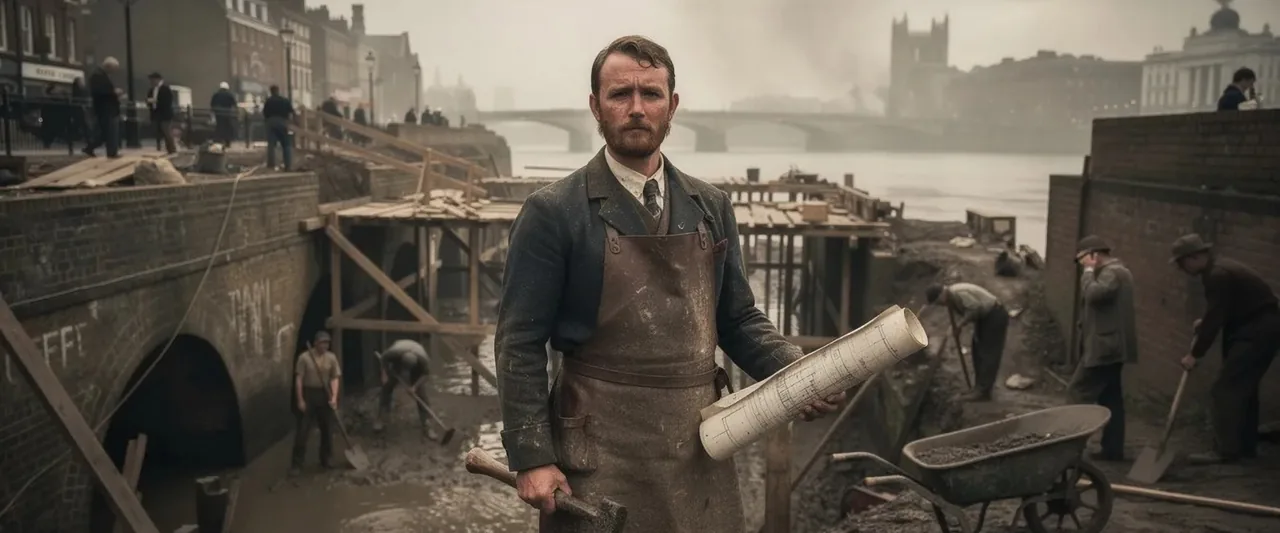
London, 1858. The flush toilet had overwhelmed the cesspits and the Thames drove Parliament from its chambers. Bazalgette did not patch the old system: he rebuilt it end to end, and doubled every pipe beyond his own calculations to carry a city that did not exist yet.
One Process, One Decision
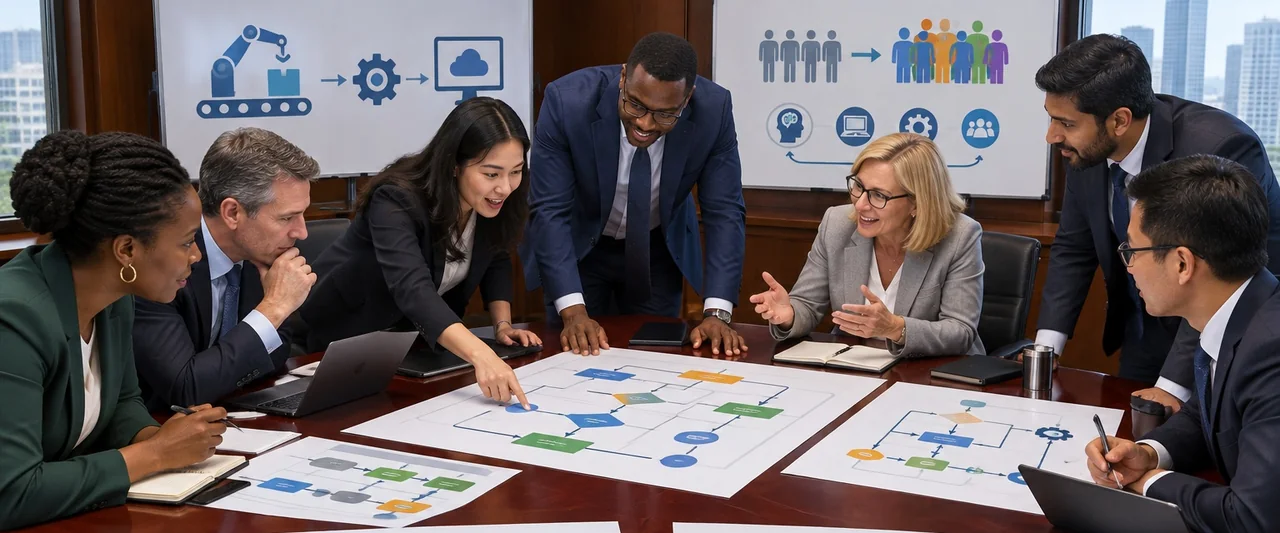
A bank has committed to 200,000 new customers a year for five years, and its sign-up process cannot deliver that. Your leaders decide how far to automate it, what that costs to build and to run, who does the work that remains, and what governance they buy before something goes wrong.
Six Steps, and a Decision at Every One
Step One
Digital application
Where the journey begins, and where most people give up.
Step Two
Identity verification
Know-your-customer checks. Security against patience.
Step Three
Financial assessment
Credit and risk scoring. Who gets in, and who is wrongly turned away.
Step Four
Account provisioning
Creating the account in systems built decades apart.
Step Five
Product configuration
Features and preferences. Compliance against flexibility.
Step Six
Activation and engagement
The moment a name on a form becomes a customer.
Each step can stay as it is or move up a tier of automation, and the steps have to work together, because completion multiplies along the chain.
Illustrative arithmetic: if every step keeps 85% of the people who reach it, 38% of those who start finish.
A process that keeps most people at every single step still loses most of them by the end. That arithmetic surprises almost every room.
The Decisions They Make
How far to automate each step, from rule-based tools to AI agents, and what each tier costs to build and to run.
How well the steps are connected, which is where most of these programmes are won or lost.
Who does the work that remains, whether the new oversight roles go to the people displaced or to new hires, and how fast the change happens.
What governance to buy. Monitoring, human review of automated declines, an audit trail, a way out of a vendor. Each is named, costed, and competing for the same budget as the automation.
How much delivery risk to carry. Scope, pace and who builds it change the odds of the thing landing, and a storm at the end tests what they bought.
One process on the table, and a room that has to agree where the automation stops.
Where the Returns Stop
Automation pays, up to a point. Every tier gets more people through the process, and every tier costs more: once to build, and then for as long as it stays in service, in licences, infrastructure and the work of keeping it upright as the systems underneath it change. Past a point the extra cost of going further, to build and to run, outgrows the extra savings it buys, and the five-year total climbs again.
So the first question is not which tier to buy. It is whether the step is worth automating as it stands, because automating a poor process only makes it a faster poor process.
The app prices every choice across the life of the contract rather than the first quarter. Recognition goes to the teams that improve the process, make the plan pay, retrain their own people and take the longer view. Not to the teams that spend the most, and not to the teams that avoid the question.
What Your People Take Away
How to read an automation business case: what is a one-off cost, what runs forever, and over what period the thing should be judged.
How to handle workforce change with both credibility and care: who is retrained, who leaves, what they are owed, and how fast it is reasonable to move.
Every figure in the simulation is sourced, dated, and shown to the room. Where we have estimated rather than measured, the app says so.
How It Runs
Two ways
Inside a Tech Tempest day, where the same teams have already designed the service they are now being asked to deliver. Or on its own for a leadership team, shaped to the group and the time you have.
Facilitator
A trained facilitator runs the session. Your people need no preparation and nothing to read beforehand.
You provide
A room, a screen, and a laptop per team. Your IT team needs shift127.com allowed through the network, or the app will not open.
We bring
The simulation, the process model and the figures behind it. Nothing is installed on your network.
Tell us whether you are thinking about The Great Stink on its own or as part of a Tech Tempest day, the size of the group and who is in the room, and we will come back with dates and a price.